Most people do not lose touch with themselves all at once.
It happens one small decision at a time.
A parent has an opinion. A teacher tells you who you are. A boss rewards the safe choice. Friends have expectations. Social media delivers another hundred examples of what your career, relationships, body, business, or life are supposed to look like.
https://www.youtube.com/watch?v=R4FdjlOibDw&t=44s
Eventually, the outside voices get so loud that it becomes difficult to recognize your own.
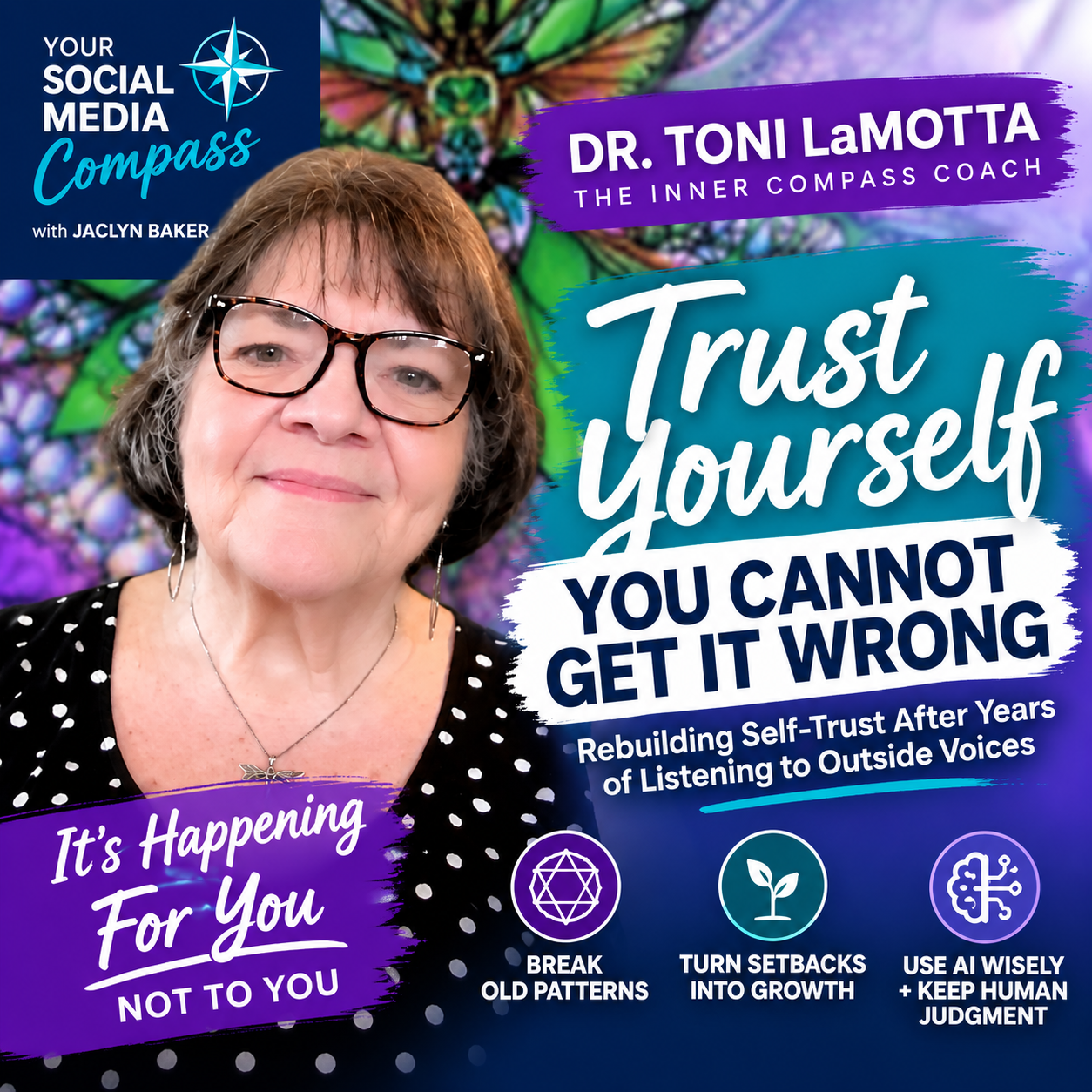
Dr. Toni LaMotta knows that experience in an unusually literal way.
Today, she calls herself the Inner Compass Coach, helping people move beyond chronic self-doubt, fear-based overthinking, and the habit of looking outside themselves for reassurance. Her work is especially focused on people who relate to Enneagram Type 6 patterns.
But long before becoming a minister, author, speaker, and coach, Dr. LaMotta spent 16 years in a convent and took a vow of obedience.
For years, authority lived outside of her. Everyday choices—from what to wear and eat to where to live and what work to do—were shaped by the structure around her.
At the time, that structure offered certainty.
Later, she began to understand what it had cost her.
“I learned later on that I was shutting down my own inner knowing,” she told Jaclyn Baker on Your Social Media Compass.
That realization now sits at the center of her work.
Dr. LaMotta is not interested in becoming another authority who tells people what to do. She wants people to become better at hearing the authority within themselves.
Why is it so hard to trust yourself?
Self-trust gets weaker every time you practice overriding it.
Sometimes that happens through people pleasing. Before asking what you think, you scan the room.
What will keep everyone happy?
What will make me look responsible?
What will prevent criticism?
What am I supposed to want?
Do that often enough and checking other people's reactions can become automatic.
Fear can create the same pattern.
Dr. LaMotta's work is particularly focused on people who identify with Enneagram Type 6 tendencies: second-guessing, scanning for potential problems, seeking reassurance, and struggling to trust an internal “yes.”
Those instincts are not always bad. Thinking ahead can protect you. Advice can save you from mistakes. Other people can see things you cannot.
The problem begins when gathering information turns into outsourcing the decision.
And today, there has never been more information to outsource it to.
There is always another expert to watch, podcast to hear, post to read, comment to consider, or AI tool to ask.
Information can make you smarter.
But more information does not automatically make you wiser.
The first step toward rebuilding self-trust, then, is surprisingly simple:
Notice whose voice you are hearing.
The next time you think, I should do this, get curious.
Who says?
Is that your considered judgment?
An old rule from childhood?
A fear of disappointing someone?
Something your industry treats as unquestionable?
A stranger's definition of success that you absorbed online?
You do not need to reject outside advice.
You simply need to recognize when someone else's opinion has quietly become your identity.
What does an inner compass actually feel like?
An inner compass is not a magical prediction system.
It will not eliminate uncertainty. It will not guarantee the outcome you want. And it certainly will not make every decision easy.
It is something more practical:
The ability to make a choice without abandoning yourself.
That distinction matters because we often imagine self-trust as certainty.
Once I'm confident enough, I'll decide.
Once I've done enough research, I'll act.
Once I'm sure this can't go wrong, I'll begin.
But self-trust often does not feel like certainty.
It feels like honesty.
You may still be nervous.
You may still ask for advice.
You may still choose something that turns out differently than you hoped.
Self-trust is knowing that, whatever happens, you can respond to what comes next.
Dr. LaMotta puts the idea in a memorable phrase:
“You can't get it wrong.”
That does not mean choices have no consequences.
It means an unwanted result does not have to become a verdict on you.
A decision can become information.
A mistake can become feedback.
A wrong turn can reveal what the right one could not.
What if you make the wrong decision?
Jaclyn shared a simple example during the conversation.
She recently bought a piece of software that appeared capable of saving her hours of work. It cost roughly $1,000.
Then she started using it.
Within days, she hated it.
So she canceled.
It would be easy to label the purchase a mistake. But making the decision also gave Jaclyn something research could not: experience.
She learned quickly that the tool was not right for her, rather than spending months forcing herself to use something simply because she had already paid for it.
That suggests a useful shift.
Instead of turning decisions into verdicts, turn them into questions:
What did this choice teach me?
What do I know now that I could not have known before?
What would I do differently next time?
What became clearer because I acted?
What part of this experience might still prove useful?
Dr. LaMotta frames this through a larger belief:
Life is happening for us, not to us.
That does not require pretending difficult experiences are pleasant or desirable.
It changes what you look for inside them.
You can remain trapped in Why did this happen to me?
Or you can eventually ask:
What can this teach me?
As Dr. LaMotta said:
“Every single thing we do is an opportunity for learning.”
The wrong path may be preparing you for the right one
Dr. LaMotta's own career offers a striking example.
After leaving the convent, she had a master's degree in mathematics and became a computer programmer.
She did not consider herself a natural programmer. The work was difficult, and at the time it may not have looked like an obvious chapter in the life of a future spiritual teacher and coach.
Years later, its value became clearer.
Technology was no longer something mysterious or intimidating. She had learned how to work through technical problems instead of immediately retreating from them.
Today, she runs an international coaching and education business, uses modern digital tools, and experiments with AI as part of her work. Her current practice incorporates the Enneagram, shadow work, self-trust practices, and other approaches through her Inner Compass work.
The chapter that once looked mismatched helped prepare her for a later one.
That is worth remembering when your own path looks messy.
A career detour.
A failed purchase.
A business idea that went nowhere.
A difficult project.
A season when progress seemed painfully slow.
We naturally judge experiences by their immediate results.
But sometimes the value of an experience is not visible until much later.
You do not have to romanticize every setback.
Just leave enough room for its meaning to change.
Can AI help you trust yourself?
This question becomes more important as AI gets better at giving us answers.
Dr. LaMotta uses tools including Claude and ChatGPT for writing, troubleshooting, and reflection.
One phrase from an AI conversation stuck with her:
“I'm just your thinking partner.”
That may be one of the healthiest ways to think about the technology.
AI can organize a messy thought.
It can offer another perspective.
It can help you work through a technical problem.
It can ask questions you had not considered.
It can also be wrong.
Dr. LaMotta has encountered bad links and suggestions that did not make sense. Instead of automatically accepting the output, she questions it.
That is the important part.
The goal is not to find a machine—or a coach, author, influencer, or expert—that can finally make every decision for you.
The goal is to think more clearly.
“It brings out from us things we really already know,” she said.
Used well, technology does not have to replace your inner compass.
It can become another surface against which you examine your own thinking.
If AI has answers, why do we still need coaches?
Because information and companionship are not the same thing.
We live in an age of abundant answers.
Ask almost any question and you can receive a list of suggestions in seconds.
What is still scarce is someone who can sit with you long enough to notice the pattern underneath the question.
A good coach can hear what you keep avoiding.
Challenge a story you have repeated for years.
Notice when your words and actions do not match.
Ask the uncomfortable follow-up question.
And stay present while you figure out what you believe.
One client described Dr. LaMotta's gift as helping people discover their own wisdom rather than handing them hers.
She compares the role to a lighting director in a play.
The lighting director can point the light toward something that was already on the stage.
But the person standing there still has to see it.
And decide what to do next.
That metaphor reveals something important about self-trust:
Trusting yourself does not mean doing everything alone.
You can ask for help without surrendering responsibility.
You can seek expertise without handing someone else your identity.
You can let another person illuminate something without asking them to live your life for you.
As Dr. LaMotta says:
“We need one another.”
Pay attention to the voices you keep close
Your inner compass belongs to you.
But your environment affects how easily you can hear it.
Dr. LaMotta says she grows through association: when the people around her change, her life changes too.
That does not mean surrounding yourself with people who agree with everything you say.
Agreement is not the same thing as support.
Instead, pay attention to what happens to you around the people you invite closest.
Do you become smaller?
More afraid?
More dependent on approval?
Do you constantly feel the need to perform?
Or do those relationships make you more honest, curious, capable, and willing to act?
The best people in your life do not need to take over your compass.
They help you hear it.
A five-step practice for rebuilding self-trust
You do not need to reinvent your life this week.
Start with one decision.
1. Write down the choice.
Remove the drama and state the decision as plainly as possible.
2. Identify the outside voices.
Whose expectations, advice, fears, or rules can you hear?
3. Ask what you actually want.
Before asking what will impress someone else, make you look successful, or prevent criticism, name your own preference.
4. Take the smallest useful step.
You do not always need a permanent decision. Sometimes you need an experiment.
5. Review what you learned.
Set a point when you will evaluate the choice based on experience rather than anxiety.
This is how self-trust becomes something you practice rather than something you either possess or lack.
You are allowed to gather information.
You are allowed to ask for help.
You are allowed to make a decision that does not work.
You are allowed to change your mind.
The goal is not to stop listening to everyone else.
It is to stop disappearing from your own decisions.
Dr. LaMotta's invitation is to consider the possibility that life is happening for you rather than simply to you.
That belief may not change the facts of a difficult day.
But it can change the question you ask next.
And sometimes, that is enough to hear your own voice again.
Connect with Dr. Toni LaMotta
Dr. Toni LaMotta is a spiritual teacher, author, speaker, and the Inner Compass Coach. Her work focuses on helping people move beyond fear, self-doubt, and outsourced authority toward greater self-trust. She is also president of Paths to Transformation.
Learn more about her work, books, workshops, and coaching at Paths to Transformation.
Turn one conversation into a month of content
This episode and its supporting assets were produced with Vivin Sales.
Vivin helps B2B founders turn a podcast into a complete sales and marketing engine—from ideal-guest booking and production to clips, articles, newsletters, and social content.